Cultivated chicken has the potential to reduce water use in meat production but is not yet consistently more efficient than conventional poultry farming. Here's what you need to know:
- Conventional poultry farming uses significant water, with most of it tied to growing feed crops. Producing 1 kg of chicken meat requires around 4,325 litres of water on average.
- Cultivated chicken, grown from animal cells in a bioreactor, currently uses about 160 litres of water per kilogram. This is similar to water-intensive poultry systems in the US but higher than some European systems.
- Key challenges for cultivated chicken include water-intensive cleaning processes and the lack of water recycling in production facilities.
- Improvements in water recycling, better growth media, and optimised bioreactor designs could lower water use in cultivated chicken production over time.
For now, cultivated chicken shows promise but requires further advancements to consistently outperform conventional poultry in water efficiency.
Water Use in Conventional Chicken Farming
Where Water Goes in Poultry Farming
In chicken farming, the majority of water consumption is tied to feed production. Over 90% of global livestock water use is attributed to growing animal feed like wheat, maize, and soya, which are staples in broiler chicken diets [5]. Whether sourced from rainfall or irrigation, producing these crops demands significant water resources.
On-farm water usage, such as the water chickens drink and the water used for cleaning facilities, represents only a small portion of the total. On average, producing 1 kilogram of chicken meat requires 4,325 litres of water [4]. That's the equivalent of filling about 4,325 standard water bottles for every kilogram of chicken produced.
Breaking this down, 82% of chicken's water footprint comes from green water (rainfall absorbed by soil and plants), with blue (surface and groundwater) and grey water (polluted water) also contributing to environmental impacts of water use [4]. These figures can vary widely depending on farming practices and regional conditions.
How Water Use Varies by Region
Where feed is grown plays a major role in determining a farm's water footprint. In areas that depend on irrigation, such as parts of North America and Eastern Asia, the reliance on surface and groundwater leads to a higher blue water footprint. Conversely, regions like South America, where feed crops are more often rainfed, experience less strain on freshwater resources [5].
Efficiency in production systems also influences water use. Industrial broiler farming, common in countries like the Netherlands and the USA, generally achieves better feed conversion rates. This means less feed - and therefore less water - is required to produce the same amount of meat compared to mixed or backyard farming systems. For example, the water footprint of chicken meat in the Netherlands is approximately 2,208 m³ per tonne, while in India, where mixed systems dominate, it climbs to 7,736 m³ per tonne [4].
"Feed production water accounts for the majority (>90%) of global livestock water withdrawals, though there is regional variation." - Dominik Wisser et al., Water, 2024 [5]
How Chicken Compares to Other Meats
When stacked against other conventional meats, chicken emerges as the most water-efficient option. Its global average water footprint of 4,325 m³ per tonne is significantly lower than that of pig meat (5,988 m³/tonne), sheep meat (10,412 m³/tonne), and beef (15,415 m³/tonne) [4]. The key factor here is feed conversion: producing beef requires around 11 times more feed per kilogram of meat than chicken, driving up its water demand [4].
| Meat Type | Total Water Footprint (m³/tonne) |
|---|---|
| Chicken | 4,325 |
| Pig | 5,988 |
| Goat | 5,521 |
| Sheep | 10,412 |
| Beef | 15,415 |
Source: Mekonnen and Hoekstra [4]
However, while chicken is more water-efficient than other meats, it still uses about 1.5 times more water per gram of protein than plant-based options like lentils and chickpeas [4]. Given that chicken is the most widely consumed meat globally, the overall water demand for its production remains immense. This underscores the importance of considering alternatives, such as cultivated chicken, to further mitigate water use. Understanding how cultivated meat is made helps explain why it requires so much less water than traditional farming.
sbb-itb-c323ed3
Water Facts: Why Beef Uses 50 Times More Water Than Plant Foods
Water Use in Cultivated Chicken Production
Compared to traditional methods, the water usage in cultivated chicken production shows potential for improvement, but it remains a complex issue.
What Life Cycle Assessments Show
Life cycle assessments (LCAs) reveal that water savings in cultivated chicken production are less straightforward than land use reductions. Recent industrial-scale LCAs indicate that water use is currently comparable to, or even higher than, conventional poultry, depending on production methods and geographical location [1].
A 2026 peer-reviewed LCA using BeneMeat's industrial data highlights the challenge: while land use is significantly reduced, water consumption remains high. The main issue lies in the current process design, which treats residual growth medium as a by-product rather than recycling it [1][2].
"Water use was found to be comparable to more water-intensive livestock systems, particularly in the US, and higher than some European systems." - PPTI News [1]
The sections below explore water use across different production stages and the factors influencing efficiency.
Water Use at Each Production Stage
Water consumption varies across the production process. Here's a breakdown of the primary uses:
| Production Stage | Primary Water Use |
|---|---|
| Media Preparation | Reverse osmosis demineralisation; dissolving glucose, salts, and soy protein isolate [2] |
| Bioreactor Operation | Medium solvent, cooling, sterilisation [2] |
| Downstream Processing | Cell mass separation via centrifugation; biomass inactivation [2] |
| Cleaning & Sterilisation | Bioreactor rinsing; 24-hour sanitation cycles between production runs [2] |
| Facility Operations | Laboratories, air conditioning, cooling systems, staff facilities [2] |
In BeneMeat's industrial-scale model, producing one kilogram of cultivated chicken requires approximately 160 litres of water [2]. Cleaning and sterilisation processes are particularly water-intensive, with 24-hour sanitation cycles contributing significantly to overall consumption [2]. These figures emphasise the need for targeted efficiency improvements.
Factors That Affect Water Efficiency
Three key factors shape the water efficiency of cultivated chicken production:
-
Media Formulation
The growth medium's composition plays a significant role. Ingredients like soy protein isolate and glucose have indirect water footprints tied to agricultural supply chains. The source of these ingredients and the efficiency of nutrient-to-meat conversion directly impact water demand [1][2]. -
Water Recycling
Recycling water within the facility is critical for reducing the blue water footprint. Projections for 2030 suggest that achieving recycling rates of 75% or higher could drastically lower water consumption [3]. -
Production Mode
BeneMeat employs continuous cultivation, which reduces the need for frequent cleaning and sterilisation cycles. This approach consumes less water and energy compared to older batch-based systems [1].
"Blue water use (surface and groundwater) in CM production is higher for chicken, pork, and beef from dairy cattle... This result is sensitive to internal water recycling at the facility." - Pelle Sinke, Researcher, CE Delft [3]
Water treatment, along with electricity and heat, currently accounts for 21–26% of the total environmental footprint of cultivated meat production [1]. Addressing these challenges is essential to make cultivated chicken a more sustainable option in the future.
Cultivated Chicken vs Conventional Poultry: Water Use Compared
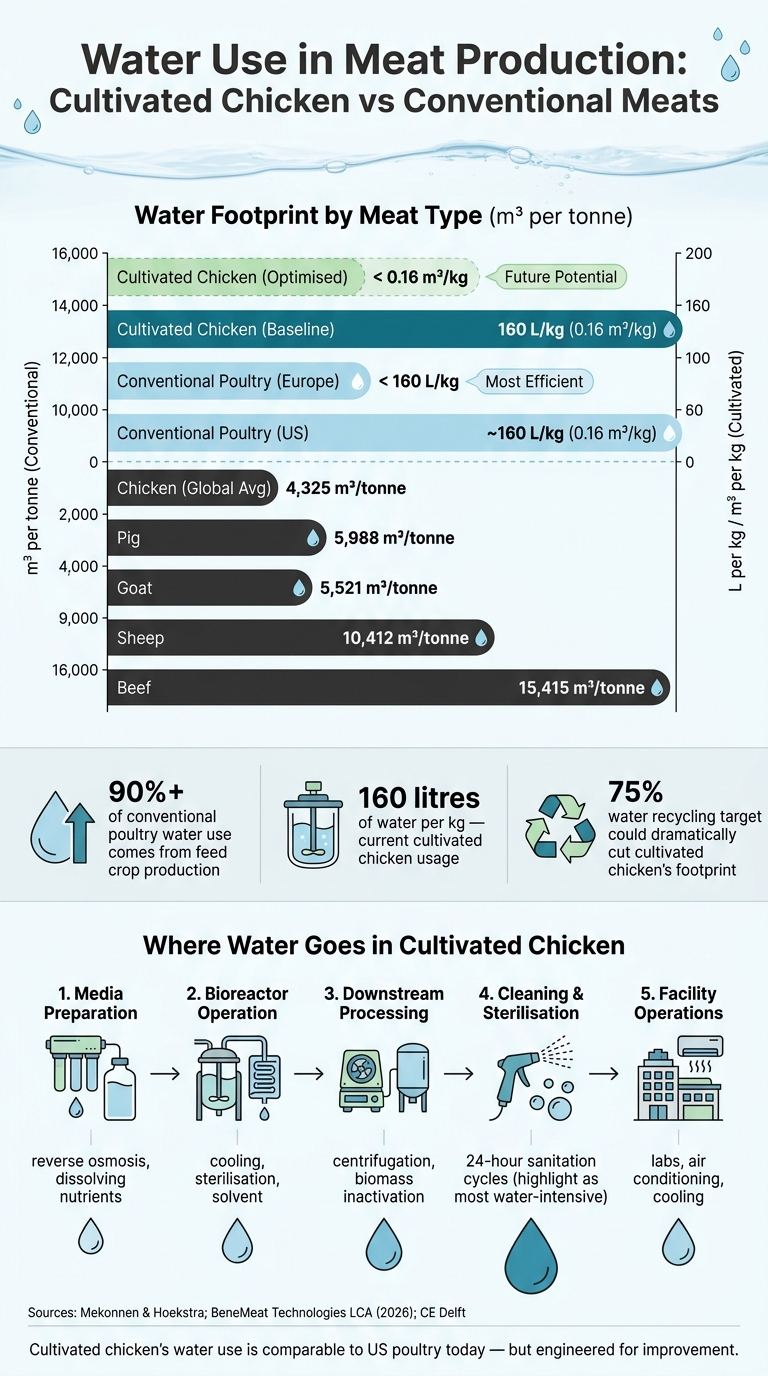
Water Use in Meat Production: Cultivated Chicken vs Conventional Meats
Water Use Across Different Scenarios
Current industrial data shows that producing 1 kilogram of cultivated chicken requires approximately 0.16 m³ (160 litres) of water. This figure is comparable to water-intensive conventional poultry systems, such as those in the United States [2].
| Production Method | Water Use (m³ per kg) | Notes |
|---|---|---|
| Cultivated Chicken (Baseline) | 0.16 | No water recycling [2] |
| Conventional Poultry (US) | ~0.16 | High water use due to feed crop irrigation [1] |
| Conventional Poultry (Europe) | < 0.16 | More efficient systems [1] |
| Cultivated Chicken (Optimised) | Potential for < 0.16 | Depends on water recycling and nutrient recovery [1] |
Interestingly, European conventional poultry farming currently uses less water than the baseline process for cultivated chicken. This highlights the potential for improvement in cultivated chicken production, particularly through process optimisation.
Why Cultivated Chicken Can Use Less Water
The difference between the baseline and optimised scenarios lies primarily in water recycling. At present, cultivated chicken production does not reclaim residual water, which increases overall consumption. However, this inefficiency stems from current process designs rather than any fundamental limitation of the technology.
"The findings demonstrate that cultivated meat, when produced at scale, can offer a comparable or lower environmental footprint than conventional chicken, particularly when key inputs and energy sources are optimised." - The International Journal of Life Cycle Assessment [2]
Another factor to consider is blue water use - the surface and groundwater associated with growing crops like glucose and soy protein isolate for the growth medium. This indirect water footprint adds complexity to the comparison, and standardised data in this area remains limited [2].
What This Means for Consumers
For now, cultivated chicken's water usage aligns closely with conventional US poultry, but there is significant room for improvement. With targeted advancements in water recycling, nutrient recovery, and process design, the environmental impact of cultivated chicken could be reduced further.
Importantly, cultivated chicken production offers a unique advantage: it can be redesigned to improve efficiency. Unlike conventional farming, which is limited by factors like land, climate, and animal biology, cultivated systems can address these challenges through engineering. Whether it’s closing the loop on water recycling, enhancing growth medium formulations, or adopting cleaner energy sources, these are solvable problems.
For consumers weighing the environmental impact of their food choices, the takeaway is clear. While cultivated chicken’s water use is not yet dramatically better than conventional poultry, its potential for improvement makes it a compelling option to watch. The direction of progress suggests that cultivated chicken could soon become a more sustainable choice.
Reducing Water Use Further: Research and Development
Better Media Formulas and Nutrient Recycling
Cutting water use in cultivated chicken production hinges on internal water recycling. According to CE Delft, achieving a 75% recycling rate in controlled production environments is ambitious but technically possible [3]. The growth medium's composition plays a major role as well. Many current formulas rely on water-heavy ingredients like soy protein isolate (SPI), which can make up 35% to 45% of the medium's total environmental impact [1]. Exploring alternatives, such as animal-free media, could lessen this strain.
In August 2024, researchers backed by Believer Meats demonstrated that a medium costing around £0.50 per litre could sustain dense chicken cell cultures for over 20 days using continuous perfusion. This setup achieved cell densities of up to 130 × 10⁶ cells per ml [6]. Meanwhile, spent media presents opportunities for nutrient recovery. Iowa State University research shows that wastewater treatment systems can reclaim up to 75% of the nitrogen from used growth medium, repurposing it as fertiliser and creating a circular nutrient recycling loop [7].
"Nitrogen management will be a key aspect of sustainability in CM production, as it is in conventional meat systems." - Gabrielle M. Myers, Iowa State University [7]
These advancements in media formulations pave the way for progress in bioreactor technologies.
Improvements in Bioreactor Design
Switching from batch processing to continuous perfusion could drastically reduce water use in bioreactor operations. Traditional batch systems require extensive cleaning after each cycle, consuming up to 45 m³ of water per bioreactor [7]. In contrast, continuous perfusion systems can operate for 60 days or more without interruption, cutting down on water-intensive cleaning cycles [8].
Future designs aim to incorporate closed-loop perfusion, which could double or even quintuple biomass concentrations. Additionally, a modular "scale-out" approach, using multiple smaller 5,000-litre units instead of a single large reactor, could minimise water waste caused by contamination events [8].
"This approach [continuous cultivation] reduces downtime for cleaning and sterilisation, improves equipment utilisation, and lowers overall energy consumption." - BeneMeat Technologies [1]
Gaps in Research and What Comes Next
Despite these strides, there are still significant research gaps. While lab-scale studies and theoretical models show promise, industrial-scale validation remains limited. Currently, water recycling is not fully integrated into most production processes, leaving this as a key area for future development [2].
Ammonia build-up in spent media is another challenge. As cells metabolise nutrients, ammonia accumulates to levels that hinder further growth, complicating media recycling. In August 2025, researchers at Texas A&M University introduced an alkalisation-stripping method that removed over 82% of ammonia from spent media. A 50:50 mix of treated and fresh media supported normal cell growth without affecting cell morphology [9]. Addressing this issue, along with better understanding inputs like enzymes and amino acids, is crucial for improving sustainability.
"Further reduction of the blue water footprint of CM is possible through further increasing recycling at the facility... and efforts in the supply chain, for example by reducing water use for production of culture medium ingredients." - Pelle Sinke, CE Delft [3]
Expanding regional studies and conducting life cycle analyses will be essential to gain a clearer picture of cultivated chicken's overall water use.
Conclusion: The Case for Cultivated Chicken on Water Use
Studies confirm that cultivated chicken production demands significantly less water compared to traditional meat sources. For instance, in April 2026, Bene Meat Technologies shared a peer-reviewed life cycle assessment based on data from their facility, which produces 400–600 kg of cultivated meat daily. Their findings highlighted a water usage figure consistent with earlier reports, showcasing a stark contrast to the higher water requirements of cultivated meat vs beef production [2][10]. This aligns with prior research emphasising the water efficiency of cultivated chicken.
While current facilities still face challenges, such as limited water recycling systems, advancements in process design and bioreactor technology are paving the way for greater efficiency. Key innovations like continuous perfusion and spent media recovery are already showing promise, with each development contributing to better resource management [1].
"The findings demonstrate that cultivated meat, when produced at scale, can offer a comparable or lower environmental footprint than conventional chicken, particularly when key inputs and energy sources are optimised." - The International Journal of Life Cycle Assessment [2]
As technology evolves, cultivated chicken is poised to become an even more sustainable choice. The Cultivated Meat Shop remains committed to tracking these advancements, sharing the latest research, and helping consumers make informed decisions. With its potential for water conservation and reduced environmental impact, cultivated chicken stands out as a forward-thinking solution in the meat industry.
FAQs
Why does cultivated chicken still use so much water?
Cultivated meat production generally requires much less water than traditional meat farming. However, certain steps in the process might appear water-heavy. This is often linked to the water needed for feed ingredients that support cell growth. Another factor is the handling of leftover growth medium, which some early systems discard instead of reusing. According to Cultivated Meat Shop, advancements like closed-loop recycling systems are helping to make water usage in production more efficient.
What makes cultivated chicken consistently more water-efficient than farmed chicken?
Cultivated chicken requires far less water compared to traditional poultry farming. This is largely because it eliminates the need for growing water-intensive feed crops, which account for a huge portion of water use in conventional methods. Production facilities for cultivated chicken also recycle water using advanced filtration systems, cutting down on waste. On top of that, precise nutrient delivery to cells and the absence of livestock housing or the need for cleaning abattoirs further reduce freshwater consumption. These factors make cultivated chicken a much more water-efficient option.
Does the water footprint vary based on production location?
The water usage for cultivated meat tends to remain steady because it’s produced in tightly controlled indoor settings. This eliminates the reliance on unpredictable factors like weather or local water supplies. Unlike conventional farming, which requires significant regional water resources for feed and livestock, cultivated meat facilities often adopt closed-loop systems. These systems recycle water effectively, ensuring minimal waste and efficient use no matter the location. This method offers a forward-thinking approach to meat production.