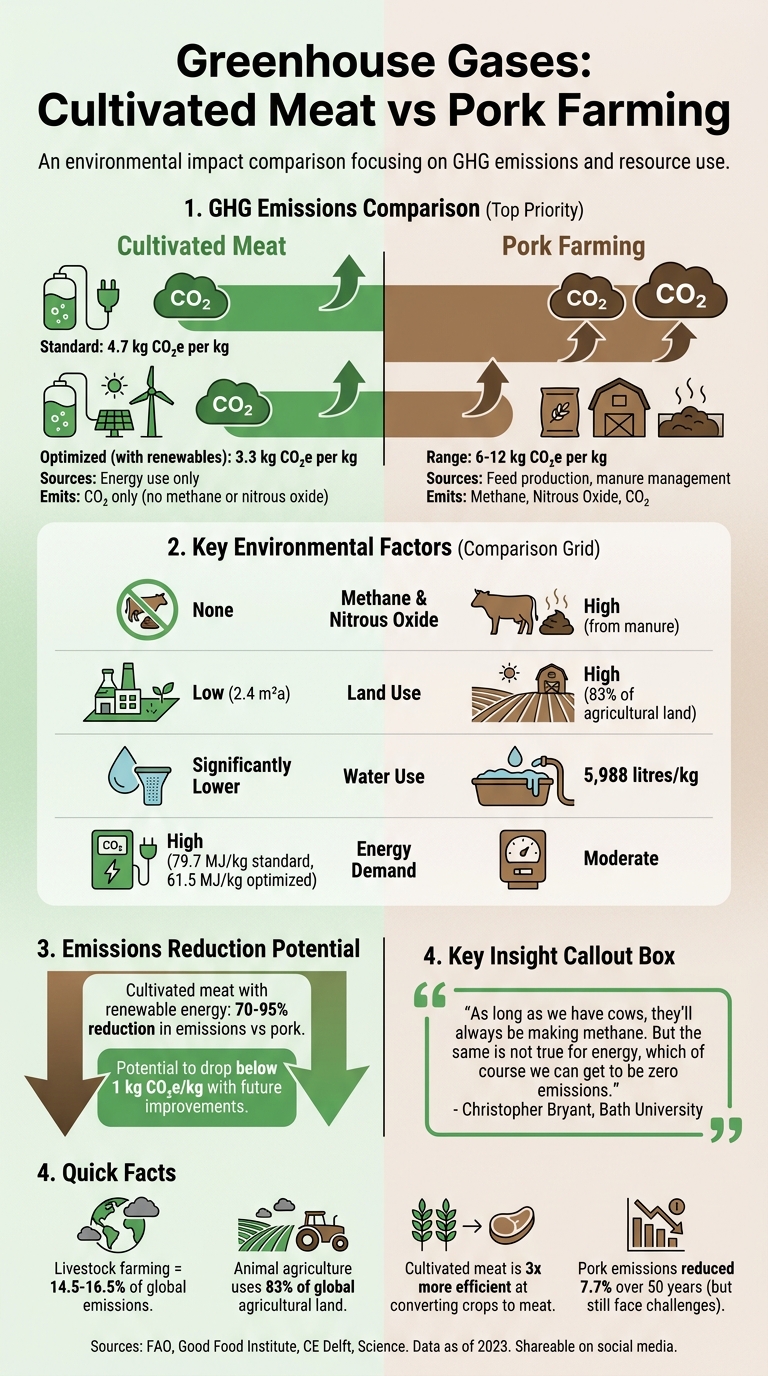
Meat production impacts the planet, but not all methods are equal. Pork farming emits methane and nitrous oxide from manure and feed production, while cultivated meat mainly generates carbon dioxide from energy use. Pork farming has reduced emissions over the years, but its reliance on livestock and land remains a challenge. Cultivated meat, grown from cells in bioreactors, avoids methane emissions entirely and has lower greenhouse gas outputs when powered by renewable energy.
Key Points:
- Pork Farming: Emits 6–12 kg CO₂e per kg of meat, primarily from feed and manure.
- Cultivated Meat: Emits 3.3–4.7 kg CO₂e per kg with current methods, with potential for further reduction using renewable energy.
- Land & Water Use: Cultivated meat uses less land and water, offering a cleaner alternative.
- Energy Dependency: Cultivated meat's emissions depend heavily on the energy mix, unlike pork farming.
Quick Comparison:
| Factor | Pork Farming | Cultivated Meat |
|---|---|---|
| GHG Emissions (kg CO₂e/kg) | 6–12 | 3.3–4.7 |
| Methane & Nitrous Oxide | High | None |
| Land Use (m²a) | High | Low |
| Water Use (litres/kg) | ~5,988 | Lower |
| Energy Demand (MJ/kg) | Moderate | High |
Cultivated meat shows promise for reducing emissions and resource use, but it depends on clean energy for maximum impact. Pork farming has improved but still faces challenges tied to livestock and land use.
Greenhouse Gas Emissions: Cultivated Meat vs Pork Farming Comparison
CE Delft | LCA of cultivated meat production in 2030
sbb-itb-c323ed3
What Are Greenhouse Gases and How Are They Measured?
Greenhouse gases are components of the atmosphere that trap heat, disrupting Earth's energy balance - a process known as radiative forcing. This trapped heat is a key driver of global warming and climate change. In food production, the main greenhouse gases of concern are carbon dioxide (CO₂), methane (CH₄), and nitrous oxide (N₂O).
Each of these gases acts differently in the atmosphere. For example, carbon dioxide stays around for thousands of years, causing a long-lasting warming effect. Methane, on the other hand, has a much shorter lifespan of about 12 years, while nitrous oxide lingers for over 100 years and has a far greater warming impact per molecule compared to the other two gases [1].
To make comparisons between these gases easier, scientists use a standardised unit called kg CO₂e (kilograms of carbon dioxide equivalent). This unit is based on the 100-year Global Warming Potential (GWP100), which measures the warming effect of a one-time emission over a century [1]. For instance, methane is about 27–30 times more potent than CO₂, and nitrous oxide is approximately 273 times more powerful.
"Individual gases differ both in the amount they change the atmospheric energy balance (radiative forcing), and hence lead to warming, and how long they persist in the atmosphere." – JL Lynch and R Pierrehumbert, University of Oxford [1]
In food production, greenhouse gas emissions are typically measured through carbon footprints, which calculate the emissions per unit of food produced - often expressed as kg CO₂e per kilogram of meat. This method allows for straightforward comparisons between different protein sources, like pork and Cultivated Meat. However, while CO₂e is a useful tool, it has limitations. It doesn’t fully account for how gases behave over time or the cumulative effects of ongoing carbon dioxide emissions [1]. This measurement approach forms the basis for comparing emissions from pork farming and Cultivated Meat production in the sections that follow.
Greenhouse Gas Emissions in Pork Farming
Emission Sources in Pork Farming
Pork farming contributes to greenhouse gas emissions at various stages, but its profile is quite different from other types of livestock farming. Unlike cattle and sheep, pigs have simple stomachs, meaning they don’t produce enteric methane through belching. This is a major advantage over ruminants. Dr. Frank Mitloehner, Director of the CLEAR Centre, highlights this distinction: "Swine are naturally less problematic than other livestock because they do not produce enteric emissions" [2].
The main sources of emissions in pork farming are feed production and manure management. Feed production introduces carbon and nitrogen into the system - carbon from the carbohydrates in grains and nitrogen from the protein sources. Pigs play a role in the biogenic carbon cycle: crops absorb CO₂ from the atmosphere, which is eventually released back through the pigs’ respiration and manure decomposition.
Manure management, however, is the largest contributor to emissions in pork farming. When manure is stored in open lagoons or uncovered pits, it breaks down and releases methane directly into the atmosphere. This makes proper storage and processing methods essential for reducing emissions.
Carbon Footprint of Pork Farming
The pork industry has made notable strides in reducing its environmental impact. Over the last 50 years, carbon emissions per pound of pork have dropped by 7.7%. At the same time, producers have significantly reduced resource use - land by 75.9%, water by 25.1%, and energy by 7% [2]. These improvements stem from breeding more efficient pigs and implementing better farming practices.
The carbon footprint of pork farming varies depending on how manure is managed. Farms using traditional open lagoons tend to emit more greenhouse gases compared to those with anaerobic digesters, which capture methane and use it as energy. In agriculture overall, manure management is a major contributor to emissions, with the sector accounting for 11% of total direct greenhouse gas emissions [2]. These figures provide a foundation for comparing the carbon footprint of cultivated vs. pork farming in later discussions.
Greenhouse Gas Emissions in Cultivated Meat Production
Emission Sources in Cultivated Meat
Unlike pork farming, which has various greenhouse gas (GHG) sources, the emissions from cultivated meat are primarily tied to energy use. The bioreactors used to grow cell cultures must maintain a steady temperature of around 37°C, requiring substantial heating, cooling, and mixing. As Ed Steele, Co-founder of Hoxton Farms, explains:
"A big part of it [energy intensity] is just running the bioreactors which, generally for mammalian cultures, need to be kept at a similar temperature to that of a body in which cells usually grow" [4].
Additional emissions come from producing essential inputs, such as Soy Protein Isolate, and from the manufacturing infrastructure, including stainless steel bioreactors and centrifuges. The carbon footprint of soy production varies depending on its origin. For instance, soy sourced from the US generally has a lower carbon footprint compared to soy from China [3].
One notable feature of cultivated meat is its minimal production of methane and nitrous oxide. Instead, nearly all its emissions are from carbon dioxide (CO₂) generated by energy consumption. This is a key distinction because methane emissions from livestock are much harder to mitigate. Christopher Bryant, a researcher at Bath University, highlights this point:
"As long as we have cows, they'll always be making methane. But the same is not true for energy, which of course we can get to be zero emissions" [4].
This reliance on energy is a critical factor in determining the overall carbon footprint of cultivated meat.
Carbon Footprint of Cultivated Meat
Large-scale production of cultivated meat is just around the corner. Bene Meat Technologies plans to open a facility in late 2025 with a production capacity of 400–600 kg per day. A Life Cycle Assessment for this facility, which uses US-sourced soy and the Czech Republic's 2024 energy mix, estimates emissions at 4.7 kg CO₂ eq. per kilogram of cultivated meat [3]. By incorporating solar panels to increase renewable energy use by 30% and adopting a post-2030 electricity mix, emissions could drop further to 3.3 kg CO₂ eq. per kilogram [3].
If cultivated meat production is powered entirely by renewable energy, it could reduce global warming impacts by as much as 80%. Techno-economic studies by CE Delft for the Good Food Institute suggest this would result in a 52% reduction in emissions compared to conventional pork [4]. However, it’s worth noting that while fossil fuels contribute only about 20% of emissions in traditional meat supply chains, the energy-intensive nature of cultivated meat means its carbon footprint is highly dependent on the energy mix used.
Direct Comparison: Cultivated Meat vs Pork Farming
Emissions Data Comparison Table
Here's a direct comparison of greenhouse gas (GHG) emissions, land use, and energy demand between cultivated meat and conventional pork:
| Production Method | GHG Emissions (kg CO₂ eq/kg) | Land Use (m²a) | Energy Demand (MJ/kg) |
|---|---|---|---|
| Cultivated Meat (Standard) | 4.7 [3] | 2.4 [3] | 79.7 [3] |
| Cultivated Meat (Optimised) | 3.3 [3] | - | 61.5 [3] |
| Conventional Pork | Predominantly higher [3] | - | - |
In the standard scenario, cultivated meat produced with US-sourced soy and a 2024 electricity mix generates 4.7 kg CO₂ eq. per kilogram. However, by implementing identified improvements, emissions drop to 3.3 kg CO₂ eq. per kilogram in the optimised scenario [3].
This data comes from Bene Meat Technologies' industrial-scale facility, capable of producing 400 to 600 kg of cultivated meat daily. Unlike theoretical models, this is based on actual operational data, providing a clearer picture of the emissions reduction potential of cultivated meat [3].
Emissions Reduction Potential
The numbers above reveal how cultivated meat could significantly cut emissions compared to conventional pork. Livestock farming is responsible for 14.5% to 16.5% of global anthropogenic CO₂-equivalent emissions [3]. If current practices persist, the livestock sector could use up 49% of the global CO₂ eq. budget needed to limit warming to 1.5 °C by 2030 [3].
Switching to cultivated meat, especially in the optimised scenario, brings emissions down to 3.3 kg CO₂ eq. per kilogram when powered by renewable energy. This shift offers a meaningful way for consumers to reduce their carbon footprint [3].
One key advantage of cultivated meat is its reliance on electricity rather than methane-producing livestock. As the UK's energy grid becomes greener, the emissions from cultivated meat production will naturally decline. This is a benefit that traditional livestock farming cannot match, as methane emissions are an unavoidable part of the process [3]. As cleaner energy sources power production, cultivated meat's environmental edge becomes even sharper.
Factors Influencing Greenhouse Gas Output
Variables in Pork Farming
When it comes to pork farming, emissions are primarily driven by two key areas: feed production and land use. Nearly 80% of the world's habitable farmland is used to grow feed crops like soy and maize [3]. The sheer scale of this agricultural activity makes feed production a major contributor to greenhouse gas emissions.
Another major factor is manure management. Poorly handled waste leads to increased methane and nitrous oxide emissions, both of which are potent greenhouse gases [3]. These emissions underline the environmental challenges tied to traditional pork farming practices.
Variables in Cultivated Meat
Cultivated meat, on the other hand, has a different set of emissions drivers. Two main factors stand out: the origin and production of Soy Protein Isolate (SPI) and the energy sources used in production. According to The International Journal of Life Cycle Assessment, SPI is the "most significant environmental hotspot" in cultivated meat production [3]. The environmental impact varies depending on whether the soy is sourced from the US, China, or the Netherlands, as each region has different agricultural practices and supply chains.
Energy sources also play a pivotal role. The electricity mix powering production facilities significantly affects emissions. For example, at Bene Meat Technologies' industrial-scale facility, using a 2024 Czech electricity mix and US-sourced soy resulted in emissions of 4.7 kg CO₂ eq. per kilogram of cultivated meat. By switching to renewable energy and refining inputs, this figure dropped to 3.3 kg CO₂ eq. per kilogram [3]. As the UK's energy grid continues to incorporate more renewable sources, cultivated meat's emissions are expected to decrease further - a level of adaptability that traditional pork farming struggles to match.
Production efficiency is another critical aspect. Factors like nutrient conversion rates, medium consumption, and defect rates (currently around 20% at pilot scale [3]) all influence the carbon footprint. Facilities like Bene Meat's, capable of producing 400 to 600 kg daily [3], use controlled bioreactors operating at 37°C with consistent 4–5 day growth cycles [3]. This level of control results in predictable emissions, unlike the variability seen in pork farming. These efficiencies make cultivated meat a more stable and potentially lower-emission alternative to traditional pork production.
Other Environmental Impacts
Cultivated Meat offers benefits beyond reducing greenhouse gas emissions, addressing critical issues like land use, water consumption, and biodiversity. These factors highlight the stark contrasts between Cultivated Meat and traditional pork farming.
Land use is one of the most striking differences. Currently, animal agriculture takes up a massive 83% of global agricultural land [5]. This is largely due to the need for feed crops like soy and maize, as well as space for livestock. While pork farming is more efficient than beef farming, it still requires significant land resources. Cultivated Meat changes this equation. Research published in The International Journal of Life Cycle Assessment shows that Cultivated Meat is three times more efficient at converting crops into meat compared to conventional livestock [5]. This efficiency could free up vast areas of agricultural land, enabling its use for carbon sequestration or restoring biodiversity, directly addressing habitat loss. Additionally, this reduced land demand eases the strain on water resources.
Water consumption is another area where Cultivated Meat has the potential to make a big difference. Producing 1 kg of pork uses an astonishing 5,988 litres of water - nearly five times more than corn and over 20 times more than potatoes [6]. With animal agriculture accounting for 41% of global green and blue water use [5], the pressure on freshwater supplies is immense. Cultivated Meat, produced in controlled environments, could significantly lower water usage compared to conventional meats [5]. However, the exact savings depend on the specific production methods and energy sources employed.
Biodiversity loss is also a major concern. According to The International Journal of Life Cycle Assessment, animal agriculture has a disproportionately negative impact on biodiversity compared to other food systems [5]. Pork farming contributes to deforestation, habitat destruction, and nitrogen pollution from manure. Cultivated Meat, on the other hand, is grown in bioreactors, eliminating the need for manure and reducing harmful waste streams [5]. By replacing vast farmlands with compact production facilities, Cultivated Meat could help preserve natural habitats, offering a much-needed boost to wildlife conservation and ecosystem health.
Conclusion
Cultivated Meat offers a much lower greenhouse gas footprint compared to traditional pork farming. For context, pork farming in the UK produces an average of 7 kg CO₂e per kilogram, with a range of 6–12 kg CO₂e/kg, largely due to manure management and feed production [7][8].
In contrast, Cultivated Meat achieves emissions of just 1.5–3.5 kg CO₂e per kilogram - a reduction of 70–95%. With advancements in renewable energy, this figure could drop below 1 kg CO₂e/kg [9][10][11][12]. These reductions highlight its potential as a key player in creating more sustainable protein options in the UK.
Beyond emissions, Cultivated Meat also addresses other environmental challenges. It uses significantly less land and water while eliminating the issue of manure pollution, making it a cleaner alternative across multiple fronts.
While current pilot production methods require substantial energy, scaling up production could bring emissions close to zero. This shift towards low-emission proteins is no longer a distant goal but an emerging reality. For a deeper look at the technology, see our guide to cultivated meat challenges and solutions.
For more updates on sustainability, product launches, and waitlist options, visit Cultivated Meat Shop.
FAQs
Why does pork farming emit methane if pigs don’t belch it?
Pork farming contributes to methane emissions primarily through the handling of manure and fermentation processes. Unlike cattle and other ruminants, pigs don’t produce much methane during digestion, meaning their emissions are not linked to belching.
How sustainable is Cultivated Meat if non-renewable energy is used?
The environmental impact of cultivated meat largely hinges on the type of energy powering its production. If non-renewable electricity is used, the carbon footprint could rise sharply, possibly matching or even exceeding that of traditional meat. To truly reduce greenhouse gas emissions, relying on renewable energy sources is essential.
What does “kg CO₂e” mean for food footprints?
“Kg CO₂e” stands for kilograms of carbon dioxide equivalent, a standard way to measure greenhouse gas emissions. It accounts for all the gases that contribute to global warming, such as methane and nitrous oxide, by converting their impact into an equivalent amount of CO₂. This makes it easier to compare the climate effects of different emissions on a single scale.