Cultivated meat tastes almost identical to conventional meat, making it a promising option for everyday meals. It replicates the flavour, texture, and aroma of traditional chicken, beef, pork, and seafood. In blind taste tests, 80–90% of participants couldn't tell the difference when used in dishes like shepherd's pie, chicken tikka masala, or fish and chips.
Key points about cultivated meat:
- Chicken: Mild, savoury, and tender, perfect for frying or stir-fries.
- Beef: Rich, umami-packed, with consistent marbling, great for burgers and curries.
- Pork: Juicy and sweet-salty, ideal for sausages or bangers and mash.
- Seafood: Flaky and buttery, works well in pasta or grilled as fillets.
It cooks like conventional meat, browning beautifully due to the Maillard reaction. With uniform quality and no variations caused by animal diet or stress, it offers consistency in every meal. Expected to hit UK supermarkets by 2027, it could soon become a regular choice for those seeking flavourful, reliable meat alternatives.
World's First Cultivated Meat Blind Tasting
sbb-itb-c323ed3
What Does Cultivated Meat Taste Like?
Cultivated meat is grown from animal cells in carefully controlled environments. Since it’s made from the same muscle, fat, and connective tissues as traditional meat, its taste and texture are strikingly similar to what you’d expect from conventional cuts. In fact, a 2025 study conducted by the University of Bath revealed that 82% of sensory evaluations found cultivated beef indistinguishable from grass-fed British beef, particularly in terms of mouthfeel and aftertaste [1].
The secret lies in its biology. Cultivated meat contains the same proteins, fatty acids, and myoglobin - the compound responsible for meat’s colour and savoury flavour - as traditional meat. This allows it to undergo the same chemical processes, like the Maillard reaction, which creates that delicious browned crust on a steak or burger [4]. One standout feature of cultivated meat is its consistency. Unlike traditional meat, which can vary depending on an animal’s diet, stress, or age, cultivated meat is produced under uniform conditions, ensuring steady flavour and texture every time. Producers can even tweak fat content or marbling to enhance juiciness or create healthier alternatives [4].
Here’s a closer look at how these qualities shine in chicken, beef, pork, and seafood.
Cultivated Chicken: Taste and Texture
Cultivated chicken offers a mild, savoury flavour with a tender texture comparable to conventional chicken. Thanks to its controlled production, it achieves a perfect crisp when fried, making it ideal for dishes like chicken tacos with fresh salsa and lime or quick stir-fries with peppers and soy sauce. A 2025 trial by Aleph Farms with UK tasters found a 90% similarity in juiciness and chew, with experts praising its ability to absorb seasonings beautifully [1].
Cultivated Beef: Flavour Profile
Cultivated beef delivers a rich umami flavour, thanks to naturally occurring glutamates, and has a marbled texture that melts into juicy perfection when cooked. Every bite maintains consistent marbling and flavour due to the controlled production process. In tastings, 87% of UK panellists rated its savouriness on par with conventional minced beef [1]. It’s perfect for British classics like slow-cooked beef curries with garam masala or juicy burgers topped with cheddar and caramelised onions. The Maillard reaction ensures a realistic sear and mouthfeel, making it almost indistinguishable from traditional beef.
Cultivated Pork and Seafood: Taste Characteristics
Cultivated pork captures the sweet-salty flavour and juicy, snappy texture of conventional pork. It even mimics the herby, garlicky notes typical of Cumberland sausages. A 2025 test by Prolific Machines found an 85% sensory match, with testers particularly impressed by its fat rendering and crispy skins [1]. It works wonderfully in dishes like bangers and mash, paired with creamy mashed potatoes, onion gravy, and peas.
Cultivated salmon replicates the buttery, oceanic flavour and flaky texture of wild Scottish salmon. In BlueNalu’s 2025 UK taste trials, it achieved a 92% similarity, thanks to precise fat cell replication [1]. Whether in seafood pasta with linguine, cherry tomatoes, and white wine or as a standalone fillet, its fresh, non-fishy taste and tender flakes absorb sauces just as beautifully as traditional salmon.
How Cultivated Meat Works in Everyday Dishes
Cultivated meat is crafted to serve as a direct replacement for traditional meat in all your favourite recipes. It’s designed to replicate the taste, aroma, and texture of conventional meat, making it an easy addition to your regular cooking habits. Researchers have even developed "switchable" flavour compounds that release savoury, fruity, and meaty aromas when heated to around 150°C, closely mimicking the flavour profile of traditional beef.
In July 2024, biomolecular engineer Milae Lee and her team at Yonsei University in Seoul showcased this innovation using a hydrogel scaffold. An electronic nose confirmed that three Maillard-reaction products successfully recreated the distinct flavour of meat. As Milae Lee explained:
"To our knowledge, it's the first approach to regulate the flavour properties of cultured meat."
This technological advancement means cultivated meat not only browns and sizzles like its conventional counterpart but also smells just as tempting in your kitchen. Hydrogel scaffolds allow the cells to grow into familiar forms - whether it’s meatballs, steaks, or mince. Researchers are now expanding this technique to match the flavour profiles of other meats like pork, chicken, and seafood, ensuring these options work perfectly in a wide range of dishes [5].
Classic British Meals
The engineered flavours and textures of cultivated meat make it an excellent fit for cherished British recipes. Imagine a golden roast chicken with crispy skin, paired with fluffy Yorkshire puddings and rich gravy - cultivated chicken can deliver all of that. In shepherd's pie, cultivated lamb mince provides the hearty, savoury base beneath creamy mashed potato, baked to perfection. Even the quintessential fish and chips can be reimagined with cultivated cod or haddock, offering the same flaky texture and crispy batter, served with mushy peas and tangy tartare sauce. Whether it’s a Sunday roast or bangers and mash, cultivated meat ensures these comforting meals retain their traditional appeal.
International Dishes and Cuisines
Cultivated meat isn’t just about British classics - it shines in global cuisines too, thanks to its ability to absorb spices and seasonings from around the world. In curries, cultivated chicken or beef soaks up turmeric, cumin, and garam masala, creating aromatic dishes like chicken tikka masala or beef rendang. For stir-fries, cultivated pork or chicken blends seamlessly with soy sauce, ginger, and garlic, offering the same tender texture and rich flavour as conventional meat.
Tacos can be transformed with cultivated beef mince seasoned with chilli and lime, topped with fresh salsa and coriander. In pasta dishes, cultivated pork mince works beautifully in a slow-simmered Bolognese with tomatoes, red wine, and herbs, while cultivated salmon adds richness to a creamy linguine with white wine and cherry tomatoes.
"It is really important to make sure that cultivated meat can match consumer expectation." – Seren Kell, Head of Science and Technology, Good Food Institute Europe [5]
Cultivated Meat vs Conventional Meat: Taste Comparison
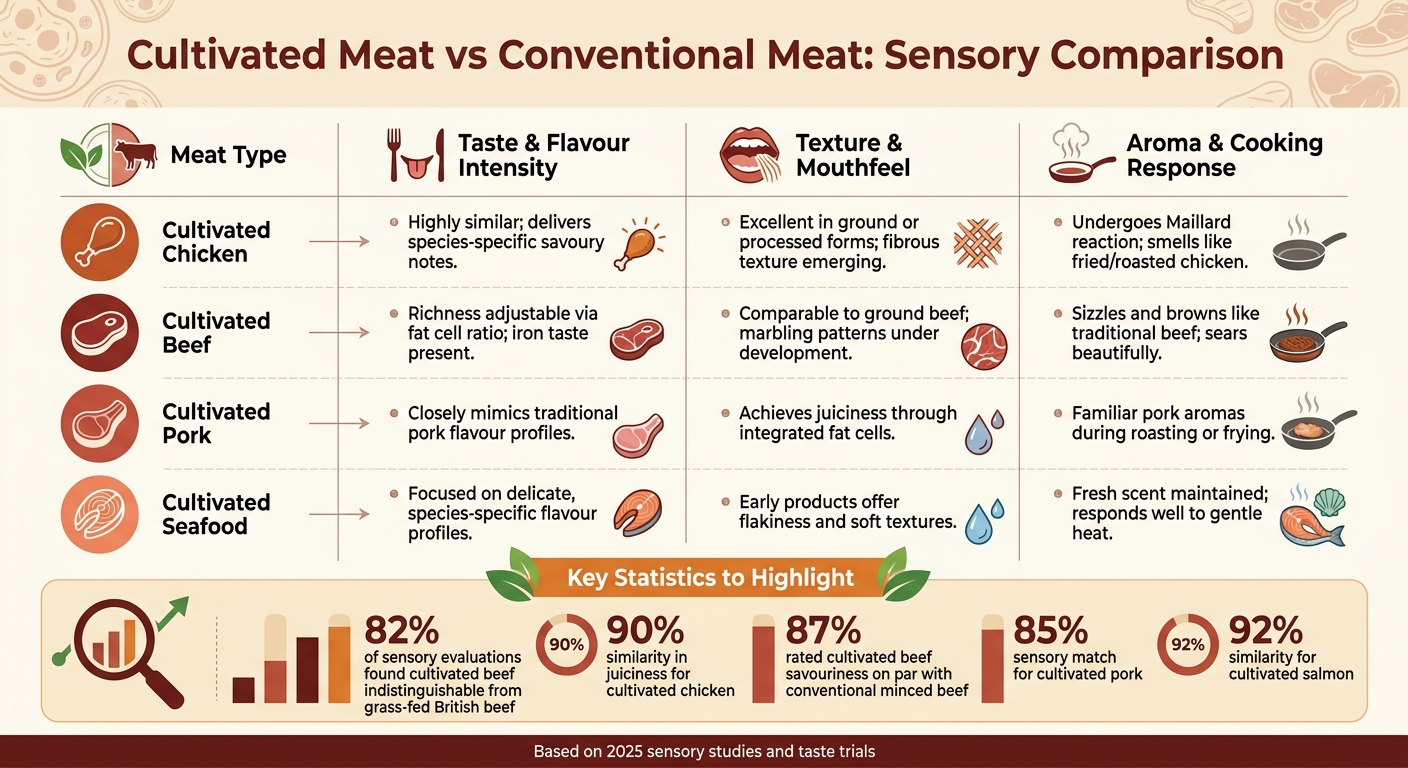
Cultivated Meat vs Conventional Meat: Taste and Texture Comparison
Let’s dive into how Cultivated Meat stacks up against conventional meat when it comes to taste.
Cultivated Meat is designed to mirror the biochemistry of conventional meat, ensuring the same flavour intensity. Key components like myoglobin and fatty acids are identical, giving it that unmistakable "meaty" taste - whether it’s the iron-rich notes in beef or the savoury richness of other cuts. Because it contains the same muscle proteins, fat cells, and connective tissue, it delivers the authentic flavours you'd expect from traditional meat.
When cooked, Cultivated Meat develops the same complex aromas and flavours through the Maillard reaction - the chemical process responsible for the mouth-watering browning and caramelisation of meat. Unlike conventional meat, which can vary in taste due to factors like the animal’s diet, age, or stress, Cultivated Meat offers a consistent flavour profile. This reliability makes it a dependable choice for recipes, whether you're grilling, frying, or marinating.
"Cultivated meat isn't an imitation or alternative to conventional meat – it's real meat, just produced through a different method." – Cultivated Meat Shop
Taste testers have noted that Cultivated Meat products like nuggets and burgers are almost indistinguishable from their conventional counterparts, especially when seasoned or used in dishes with multiple ingredients. Everyday meals like curries, stir-fries, and roasts integrate seamlessly with these products. Chefs also highlight the benefits of its clean production process and uniform quality, which are game-changers in professional kitchens. While ground meat products like burgers and nuggets are currently the most developed, the texture of whole cuts, such as steaks, is still being fine-tuned to replicate the intricate fibre alignment of traditional muscle.
One standout feature of Cultivated Meat is the ability to customise fat distribution. This enhances the richness and ensures a consistent iron-rich flavour across every portion. Whether you’re preparing a hearty Sunday roast or a quick stir-fry, you can rely on the same level of tenderness and taste each time.
Sensory Comparison Table
| Category | Taste & Flavour Intensity | Texture & Mouthfeel | Aroma & Cooking Response |
|---|---|---|---|
| Cultivated Chicken | Highly similar; delivers species-specific savoury notes | Excellent in ground or processed forms; fibrous texture emerging | Undergoes Maillard reaction; smells like fried/roasted chicken |
| Cultivated Beef | Richness adjustable via fat cell ratio; iron taste present | Comparable to ground beef; marbling patterns under development | Sizzles and browns like traditional beef; sears beautifully |
| Cultivated Pork | Closely mimics traditional pork flavour profiles | Achieves juiciness through integrated fat cells | Familiar pork aromas during roasting or frying |
| Cultivated Seafood | Focused on delicate, species-specific flavour profiles | Early products offer flakiness and soft textures | Fresh scent maintained; responds well to gentle heat |
The Future of Everyday Meals with Cultivated Meat
Cultivated Meat is on the verge of becoming a staple in British kitchens. With taste tests confirming its flavour and texture, and production processes proving reliable, regulatory approvals are expected soon. The Food Standards Agency is anticipated to greenlight it by late 2026, with supermarket shelves likely to stock it by mid-2027. This real meat, grown directly from animal cells without the need for slaughter, offers a compelling alternative for everyday meals in the UK [1].
Experts are optimistic about its adoption. Prof. Rachel Brown from the University of Bath predicts that by 2035, Cultivated Meat could account for 20% of the market, making it a regular feature in weekly grocery shopping alongside traditional meat options [1]. A 2024 University of Cambridge study supports this, showing that 85% of taste-test participants couldn’t distinguish Cultivated Meat from grass-fed mince, ensuring it meets expectations for dishes ranging from Sunday roasts to quick stir-fries [1].
What makes Cultivated Meat even more appealing is its environmental edge. Modelling by Oxford University in 2025 suggests it could slash meat-related emissions by 80–90%, while using 95% less land and 78% less water compared to conventional beef [6][3]. For UK households aiming to reduce their carbon footprint, this means enjoying beloved meals like fish and chips or a full English breakfast with a fraction of the environmental impact. And by 2030, prices are expected to settle at around £5–7 per 450g pack, making these premium proteins affordable for everyday use rather than just special occasions [6].
Beyond sustainability, Cultivated Meat offers practical benefits. Its sterile production process eliminates contamination risks, and pre-portioned packaging makes meal prep straightforward - whether you’re batch-cooking a curry or whipping up tacos on a busy weeknight. Additionally, its potential for nutritional customisation, such as omega-3 enriched salmon or low-fat beef, caters to health-conscious families while maintaining its high sensory quality [1][2].
For those keen to stay ahead, platforms like Cultivated Meat Shop provide valuable updates. By joining waitlists, you can receive early access notifications, discover recipes - like incorporating cultivated chicken into tikka masala or using cultivated beef for a hearty bolognese - and track regulatory developments. Staying informed will help you seamlessly introduce Cultivated Meat into your cooking routine, offering a delicious and sustainable way to transform everyday meals.
FAQs
Does cultivated meat cook exactly like conventional meat?
Cultivated meat behaves much like traditional meat when cooked, offering a familiar experience in the kitchen. It browns beautifully and gains rich flavours through the Maillard reaction, making it perfect for a variety of dishes such as stir-fries, burgers, or curries. Its adaptability means it can easily fit into your go-to recipes without any fuss.
Will cultivated meat taste different in strongly spiced dishes?
In dishes with strong spices, cultivated meat might come across as slightly milder and less layered in flavour. That said, the right seasoning and cooking methods can easily bring out its taste, making it adaptable to a wide range of culinary styles.
When will cultivated meat be available in UK supermarkets?
Cultivated meat could be hitting UK supermarket shelves by 2026. According to Cultivated Meat Shop, preparations are underway for its launch, and there are even plans for direct-to-consumer delivery options. Keep an eye out for updates as this new food option becomes available to more people.